
SoAP screening services
Outsourced peptide discovery against a defined protein target.
AEBi screens a client-selected protein with SoAP, confirms the interaction experimentally by ELISA and delivers the resulting peptide sequences — typically within three months, subject to target suitability and project scope.
The opportunity
Outsourcing the longest step in discovery.
Many programmes require peptides that bind a given protein or modulate a protein–protein interaction. Conventional approaches can involve years of work, large libraries and several optimization rounds before a useful candidate emerges. AEBi undertakes one well-defined step of that path.
Scope of service
- 01Screening for peptide sequences that interact with customer-selected protein targets.
- 02Application of AEBi's proprietary SoAP peptide-screening technology.
- 03Generation and evaluation of peptide candidates against the specified target.
- 04Experimental confirmation of peptide–protein interactions using ELISA-based assays.
- 05Delivery of candidate peptide sequences with supporting screening results.
- 06A target-focused service that slots into an existing discovery programme.
- 07Optional follow-up collaboration for optimization, characterization and additional testing.
Three-month deliverable
Deliverables at project close.
For a suitable target and an agreed scope, the project concludes with a documented package of results rather than a proposal for future work.
Peptide sequences
Selected sequences identified against the agreed protein target.
ELISA proof
Experimental results supporting interaction with the target protein, measured on the phage-displayed peptides rather than on free synthetic peptides.
Screening data
The underlying data and identification of the most promising candidates.
Technical report
A concise report summarizing the screening and validation results.
The exact number of peptide candidates, assay configuration, validation criteria and timeline are defined for each project, based on the target protein and the customer's requirements.
Screening results
What a campaign actually produces.
Screening output is only a result once the interaction has been measured. These are readouts from three of AEBi's own campaigns — GST, POSH and EGFR — in the order they were run: ELISA against the target and its controls, a FRET assay on synthesized peptides, and cell-based assays on the resulting antagonists. Note that the ELISA readout is measured on peptides still displayed on the phage, not on free synthetic peptides; synthesis begins only after the binding clones are chosen.
ELISA
The plate that closes each campaign: selected phage clones are tested against the target protein and against controls coated alongside them. The peptides under test are displayed on the phage surface, not supplied as free synthetic peptides.
FRET assay
Peptides selected on the plate are synthesized and titrated into a biochemical assay, to see whether they inhibit the protein–protein interaction itself.
Functional assay
The final readout is functional rather than binding-based: does the peptide change what the target does in a cell, and does it survive conditions closer to use?
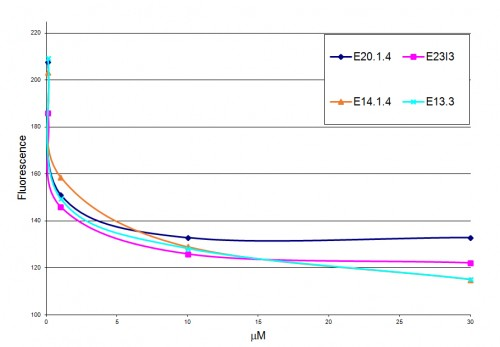
Figures reproduced from AEBi study reports and the SoAP Technology presentation. Assay format, controls and acceptance criteria are defined for each project. The ELISA readout is obtained with peptides displayed on the phage, not with free synthetic peptides. SoAP applies selective pressure toward functionality at every selection round, but AEBi does not undertake that the peptides delivered will necessarily be functional: activity is established experimentally, case by case, in the assays agreed for the project.
Why the economics work
A single platform and a lean organisation, reflected in project pricing.
A conventional discovery campaign spreads budget across library construction, chemistry, screening and optimization before a lead appears. The library is already built and the platform is owned in-house, so a project is scoped to a single step: the client's target, screened and validated.
This is why a SoAP programme is priced well below the equivalent work by other routes. The difference is stated in the project proposal rather than implied in marketing.
Library build · multiple optimization rounds · chemistry · screening
Target in · screening · ELISA validation · sequences out
Indicative scope comparison, not a quotation. Projects are priced individually.
Potential applications
Applications of a validated peptide.
- Discovery of peptide therapeutics
- Inhibitors or modulators of protein–protein interactions
- Research tools and molecular probes
- Target validation and early-stage drug discovery
- Ligands for difficult or previously unexplored targets
- Starting points for optimization and medicinal chemistry
Reasons to engage AEBi
The basis for a partnership.
- Proprietary SoAP technology focused on peptide–protein interaction discovery.
- A rapid path from target selection to experimentally supported candidates.
- A flexible collaboration model built for pharma and biotech partners.
- Work on customer-defined protein targets, not a fixed catalogue.
- Reduced internal time and resource allocated to early peptide discovery.
Collaboration model
A typical project, start to finish.
The client provides the protein target and the relevant technical information. AEBi defines the screening strategy, runs the SoAP-based discovery process and tests selected candidates by ELISA. The project closes with the identified sequences and the corresponding experimental results.
Fee-for-service
A defined project, a defined deliverable.
Sponsored research
A longer programme focused on a defined target area.
Strategic collaboration
Broader access to the platform and its scientists.
Collaboration
Discuss a screening project.
AEBi will assess feasibility and provide a proposed screening plan, timeline and budget. No commitment is required to open the discussion.
Request a screening plan